AI vs ML vs DL vs Data Science
Artificial intelligence is the big goal, machine learning is the main way we reach it today, and deep learning is one powerful kind of machine learning. Data science uses all of these to answer questions with data.
Your Path Through This Lesson
0 of 5 done
- Place AI, ML, DL and data science on one picture.
- Say when deep learning is worth it, and when classic ML is the better tool.
- Answer the "what's the difference?" interview question in four sentences.
One Picture First
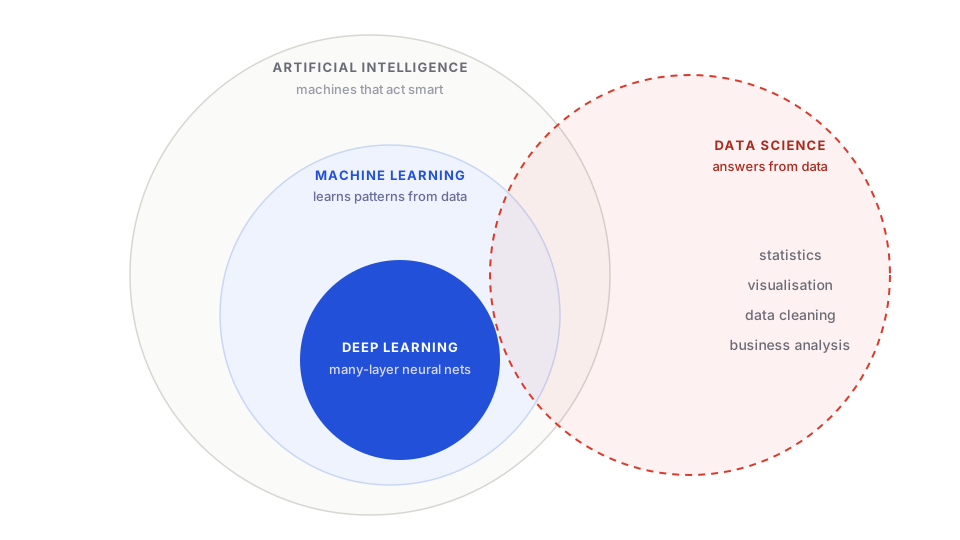
People use these four words as if they mean the same thing. They don't. The easiest way to remember them is as circles inside circles, with data science sitting across all of them.
Artificial Intelligence (AI)
AI is any technique that makes a computer do something we'd call "smart": plan, decide, recognise, understand, act.
AI is the goal, not one method. Some AI doesn't learn anything at all. A chess program from the 1990s that searched through millions of moves using rules written by experts was AI, but it had no machine learning in it.
Examples: a self-driving car, a chatbot, a game opponent, a robot vacuum planning its route.
Machine Learning (ML)
ML is the part of AI where the computer learns patterns from data instead of following hand-written rules. This is what you saw in the previous lesson: give it hours and marks, and it learns the rule.
Classic ML algorithms include linear regression, logistic regression, decision trees, random forests, k-means and support vector machines. This whole course is about them.
ML works best on tabular data: rows and columns, like an Excel sheet of house prices, loan applications or exam results.
Deep Learning (DL)
DL is the part of ML that uses neural networks with many layers. "Deep" just means many layers.
Deep learning shines where the data is huge and messy: images, audio, video and text. You don't have to tell it what to look for. A deep network learns by itself that edges make shapes, shapes make eyes, and eyes make faces.
Examples: face unlock, voice assistants, translation, and large language models like the ones behind modern chatbots.
Deep learning usually needs much more data and computing power than classic ML. For a 500-row spreadsheet, a random forest will often beat a neural network and train in a second. Pick the tool that fits the data.
Data Science
Data science is the job of turning raw data into answers and decisions. It is the widest of the four, and it isn't purely a part of AI.
A data scientist cleans data, explores it with charts, uses statistics to test ideas, and, when it helps, trains ML or DL models. Plenty of valuable data science never trains a model at all: "Which product sold best in Chattogram last Eid?" is a data science question you answer with a well-made chart.
Side by Side
| AI | ML | DL | Data science | |
|---|---|---|---|---|
| What it is | The goal: smart machines | Learning patterns from data | ML with deep neural networks | Getting answers from data |
| Learns from data? | Not always | Yes | Yes | Sometimes |
| Typical data | Anything | Tables (rows and columns) | Images, audio, text | Anything |
| Data needed | Varies | Hundreds to millions of rows | Usually a lot | Varies |
| Example | Chess engine, self-driving car | House price prediction | Face recognition | Sales dashboard and forecast |
How to Say It in an Interview
If someone asks "What's the difference between AI, ML and DL?", a clean answer is:
AI is the broad field of making machines act intelligently. Machine learning is a subset of AI where systems learn from data instead of explicit rules. Deep learning is a subset of machine learning that uses multi-layer neural networks, and it works especially well on unstructured data like images and text. Data science is the wider practice of extracting insight from data, and it uses statistics, ML and DL as tools.
For each of these, decide whether it's best described as AI without ML, classic ML, deep learning, or data science analysis: (1) a spam filter trained on labelled emails, (2) a monthly chart of hospital admissions, (3) an app that recognises plant diseases from leaf photos, (4) a traffic light that switches on a fixed timer. Answers: classic ML, data science, deep learning, and none of them, it's just a timer!
Deep learning sits inside machine learning, which sits inside AI. Data science overlaps all three.
Summary
- AI is the goal, ML is learning from data, DL is ML with deep neural networks.
- They nest: DL ⊂ ML ⊂ AI.
- Data science overlaps all of them and also includes statistics and analysis.
- Next: the two big families of ML, supervised and unsupervised learning.